
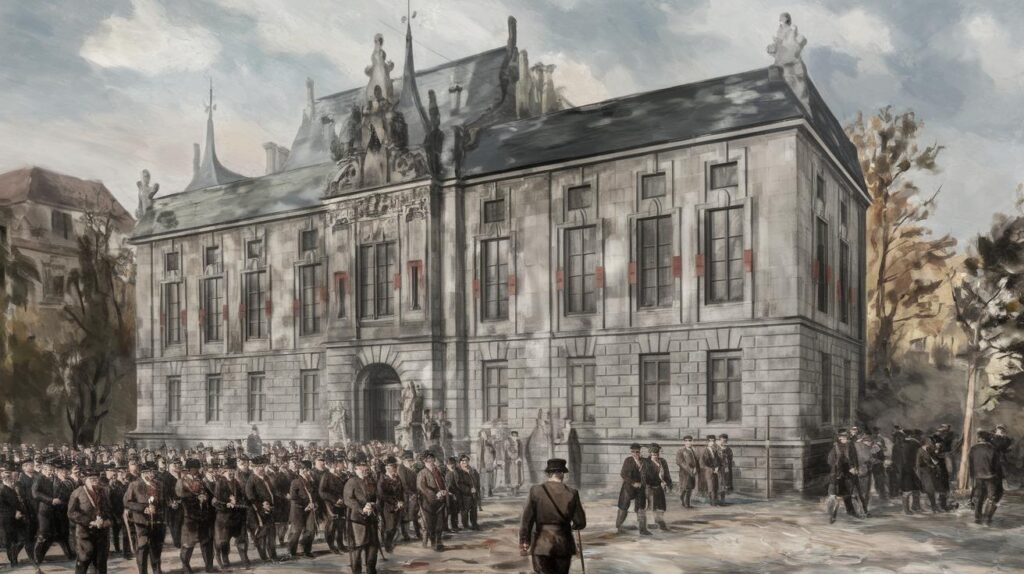
The Munich Putsch and the Targeted Weimar Government
The Munich Putsch, also known as the Beer Hall Putsch, was a pivotal moment in the history of the Weimar Republic. This blog post delves into the intricacies of the event, examining the local Weimar government that the putsch sought to overthrow. With sections detailing the background and climate of national instability that contributed to the putsch, alongside descriptions of the event itself and its aftermath, the article offers a comprehensive analysis. Additionally, it explores the legacy of the putsch and how it shaped the subsequent rise of Adolf Hitler and the Nazi Party. Rich in historical insight, this piece also provides critical thinking questions, glossary terms for better understanding, and further reading suggestions. Finally, it offers a table summarizing the lessons learned from this significant episode in German history.
Key Facts
The Munich Putsch occurred on November 8-9, 1923, in the Bavarian city of Munich. This coup attempt was led by Adolf Hitler and Erich Ludendorff, along with the Nazi Party. The aim was to overthrow the Weimar Republic’s local government in Bavaria and eventually establish a national dictatorship.
The immediate target of the putsch was the Bavarian State Government, specifically its triumvirate leadership: Gustav von Kahr, the State Commissioner; General Otto von Lossow, the local army commander; and Colonel Hans Ritter von Seisser, chief of police. Hitler envisioned leveraging Bavaria as a stronghold for launching an eventual takeover of the national government based in Berlin.
Background
After World War I, Germany faced severe political upheaval, resulting in the abdication of Kaiser Wilhelm II and the establishment of the Weimar Republic. The early years of the republic were fraught with economic challenges, political assassinations, and uprisings, which weakened the government’s authority and public confidence.
Bavaria, home to conservative and nationalist factions, harbored significant dissent against the Weimar Republic. The Treaty of Versailles, which imposed harsh reparations on Germany, fueled nationalist fervor and resentment. Many in Bavaria saw the Weimar government as illegitimate and sought a return to authoritarian rule, making it a fertile ground for Hitler’s radical ideas.
A Climate of National Instability
The climate of national instability during the Weimar Republic’s early years was exacerbated by economic woes such as hyperinflation, where the German mark lost its value dramatically. This economic crisis created widespread discontent, unemployment, and poverty, destabilizing the nation further.
Politically, the Weimar Republic faced threats from both leftist and rightist extremist groups. While communist factions pursued the establishment of a Soviet-style government, right-wing groups, including the nascent Nazi Party, aimed to dismantle the democratic institutions of the republic and impose an authoritarian regime.
The Putsch
The Munich Putsch was inspired by Benito Mussolini’s successful March on Rome. Hitler intended to emulate Mussolini’s tactics by using Munich as a base to launch a national revolution. On the evening of November 8, 1923, Hitler and his followers stormed the Bürgerbräukeller, a large beer hall where von Kahr was addressing a meeting.
Seizing control of the venue, Hitler declared a national revolution and claimed control of the Bavarian government. Despite initial support and coercion of von Kahr, Lossow, and von Seisser, the coup failed the next day when Bavarian authorities, backed by the German army, crushed the revolt by dispersing the Nazis as they marched through Munich.
Trial
In the aftermath of the failed putsch, Hitler and other conspirators were arrested and brought to trial. Despite the seriousness of the charges against him, including high treason, Hitler used the trial as a platform to promulgate his nationalist ideologies and to gain wider public attention.
The judges, sympathetic to nationalist sentiments, handed down a lenient sentence. Hitler was sentenced to five years in Landsberg Prison but served only nine months. During his incarceration, he wrote “Mein Kampf,” which outlined his political ideology and future plans for Germany, solidifying his role as the future leader of the Nazi Party.
The Legacy of the Beer Hall Putsch
Although the Munich Putsch was a failure in immediate terms, it had long-lasting implications. The trial and subsequent publicity transformed Hitler into a national figure. The strategies and lessons learned during the putsch would later be instrumental in Hitler’s rise to power through legal means.
The putsch also exposed the weaknesses of the Weimar Republic—a government struggling with legitimacy and the challenge of controlling extremist factions within Germany. These vulnerabilities facilitated Hitler’s ascension as he capitalized on the failures of the republic to gain political control in the following decade.
Series: The Weimar Republic
This article is part of a broader exploration of the Weimar Republic, shedding light on its challenges and the socio-political dynamics of post-World War I Germany. Understanding the Weimar Republic is crucial to comprehending the conditions that allowed for the rise of Nazi Germany.
Throughout this series, we aim to provide comprehensive insights not only into political movements like the Munich Putsch but also into cultural and societal shifts. The series is an invaluable resource for those interested in analyzing the fragility of democratic institutions in times of national crisis.
Critical Thinking Questions
- How did the socio-economic conditions of post-World War I Germany contribute to the rise of extremist parties like the Nazi Party?
- What role did the Treaty of Versailles play in the political instability of the Weimar Republic?
- Could the Weimar Republic have prevented the Munich Putsch, and what actions might have mitigated the nationalist threats?
See Also
Glossary Terms
-
Weimar Republic:
The democratic government of Germany from 1919 to 1933. -
Putsch:
A violent attempt to overthrow a government; a coup. -
Hyperinflation:
Extremely rapid or out-of-control inflation.
Further Reading
- Kershaw, Ian. “Hitler: A Biography.” A comprehensive study of Adolf Hitler’s rise to power.
- Mommsen, Hans. “The Rise and Fall of Weimar Democracy.” An analysis of the political dynamics of the Weimar Republic.
- Taylor, A.J.P. “The Origins of the Second World War.” Examines the interwar period and the eventual lead-up to World War II.
Lessons Learned
| Section | Summary |
|---|---|
| Key Facts | The Munich Putsch aimed to overthrow the Bavarian local government. |
| Background | Bavaria was a hotspot of nationalist dissent against the Weimar Republic. |
| A Climate of National Instability | Economic and political instability fueled the extremist threats. |
| The Putsch | Initially successful, the putsch ultimately failed due to governmental intervention. |
| Trial | Hitler used his trial as a platform for propaganda, gaining national attention. |
| The Legacy | The putsch’s failure ironically strengthened Hitler’s resolve and public profile. |

