
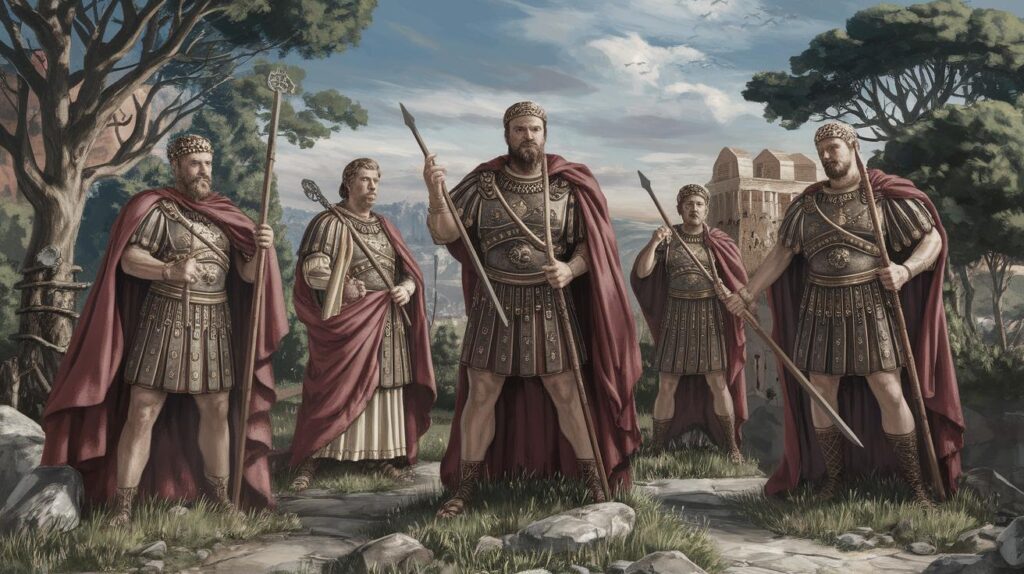
The Five Good Emperors of Rome
In the annals of Roman history, few periods shine as brightly as the era of the Five Good Emperors. These rulers, Nerva, Trajan, Hadrian, Antoninus Pius, and Marcus Aurelius, stood out for their wisdom, benevolence, and dedication to the Roman Empire’s prosperity and peace. This blog post delves into the lives and legacies of these illustrious figures, exploring how their governance not only secured Rome’s grandeur but also left an indelible mark on history. Through careful examination of their reigns, we gain insights into the qualities that made them exemplary leaders and the era they defined as one of the most stable and flourishing in Roman history.
Good or Bad Emperors?
The history of Rome is replete with emperors whose reigns were marked by infamy and tyranny. Names like Caligula, Nero, and Commodus remind us of the darker chapters of Roman rule, characterized by excess, cruelty, and mismanagement. In stark contrast, the Five Good Emperors represent a beacon of enlightened governance and restraint; their collective administration ushered in a period of relative peace, prosperity, and cultural flourishing.
But what makes an emperor “good”? Is it their policies, virtues, or the peace they maintain within their empire? Roman historian Edward Gibbon, in his seminal work “The History of the Decline and Fall of the Roman Empire,” proclaimed the era of the Five Good Emperors as the happiest and most prosperous period in Rome’s history, a testament to their exceptional leadership and integrity. By honoring merit over birthright and working harmoniously with the Senate, these emperors imparted lessons on the importance of wisdom and justice in rulership.
The Five Good Emperors
1. NERVA, the Senate’s Emperor
Nerva’s ascent to power marked a pivotal transition from the tumultuous rule of Emperor Domitian. Chosen by the Senate, this experienced senator and elder statesman tactfully navigated Rome out of dictatorship into a more constitutional regime. His short reign, lasting from AD 96 to 98, was characterized by a cooperative relationship with the Senate, marking a departure from autocratic rule towards a participatory governance model.
Despite his advanced age and the brevity of his rule, Nerva’s legacy lies in his establishment of stable succession through adoption. The decision to name Trajan as his heir, a respected general with a strong military support base, set a precedent for succession that prioritized merit and ensured the continued stability of the empire. Nerva’s actions underscored the importance of laying a sound foundation for future governance and highlighted the benefits of senatorial collaboration and prudent decision-making.
2. TRAJAN, the “Optimus Princeps”
Trajan, lauded as “Optimus Princeps,” or the best ruler, presided over the Roman Empire during a peak of territorial expansion and economic prosperity. His military conquests, most notably the Dacian Wars, not only extended Rome’s boundaries but also brought immense wealth into the empire. His passion for public projects sparked an era of grand architectural advancements, including Trajan’s Forum, which showcased his commitment to public welfare and the beautification of Rome.
Beyond conquests and construction, Trajan’s administration was marked by optimism and liberal policies that enhanced civic stability and infrastructure. By implementing the alimenta, a welfare program that supported poor children, Trajan demonstrated his humanitarian concerns and commitment to social equity. His reign from AD 98 to 117 set a high standard for leadership where military prowess, civic responsibility, and compassion worked in harmony to elevate the Roman Empire.
3. HADRIAN, the traveler
Following Trajan, Hadrian established his mark not through expansion but through consolidation and cultural patronage. Known as “Hadrian the traveler,” his extensive journeys across the empire reinforced Roman influence and governance directly through personal presence and immediate attention to provincial issues. Hadrian’s strategic withdrawal from over-expanded territories marked a pragmatic shift in maintaining Rome’s domain sustainable.
A lover of Greek culture and arts, Hadrian fostered cultural renaissance in the empire, epitomized by his construction projects like the Pantheon and Hadrian’s Wall in Britain, affirming Rome’s grandeur and securing its frontiers. His reign, from AD 117 to 138, symbolized a blend of disciplined governance, cultural investment, and a personal connection to the empire’s provinces, ensuring not just Rome’s survival, but its cultural and intellectual prospering.
4. ANTONINUS PIUS, the Wise
Under Antoninus Pius, Rome experienced a period of exceptional peace and stability. His reign from AD 138 to 161 was devoid of any major military conflicts, focusing instead on internal administration, economic prosperity, and legal reforms. Known for his fairness and benevolence, Antoninus earned the epithet “Pius” for his piety, both religiously and in his dutiful respect towards his predecessor Hadrian’s wishes.
Antoninus demonstrated profound respect for the Senate and the empire’s legal frameworks, investing in infrastructural projects and expanding Roman law’s scope to ensure justice and societal well-being. His ability to maintain tranquility and prosperity without warfare or excessive force reflects a leadership style grounded in justice, reason, and the sagacious governance that earned him the eternal respect and admiration of Roman society.
5. MARCUS AURELIUS, the Philosopher
Marcus Aurelius, often referred to as the philosopher emperor, uniquely combined philosophical wisdom with imperial duties. His reign from AD 161 to 180 was marked by challenges, including wars in the East and the Marcomannic Wars, testing the resilience of the empire. Despite these tribulations, Marcus Aurelius displayed stoic endurance and moral integrity, drawing from his meditative reflections, immortalized in his work “Meditations.”
His philosophical outlook did not detract from his responsibilities as a ruler; instead, it enhanced his capacities to lead with empathy, wisdom, and justice. Marcus Aurelius’s reign emphasized service over power, culminating in a legacy of principled leadership and introspection, providing enduring inspiration on balancing power with wisdom and ethical reflection in governance.
Lessons from the Five Good Emperors
| Emperor | Reign | Legacy |
|---|---|---|
| Nerva | AD 96-98 | Established stable succession and Senate relations |
| Trajan | AD 98-117 | Expanded the empire and endorsed public welfare |
| Hadrian | AD 117-138 | Cultural patronage and consolidation |
| Antoninus Pius | AD 138-161 | Ensured peace and legal reforms |
| Marcus Aurelius | AD 161-180 | Emphasized stoicism and compassionate leadership |

