
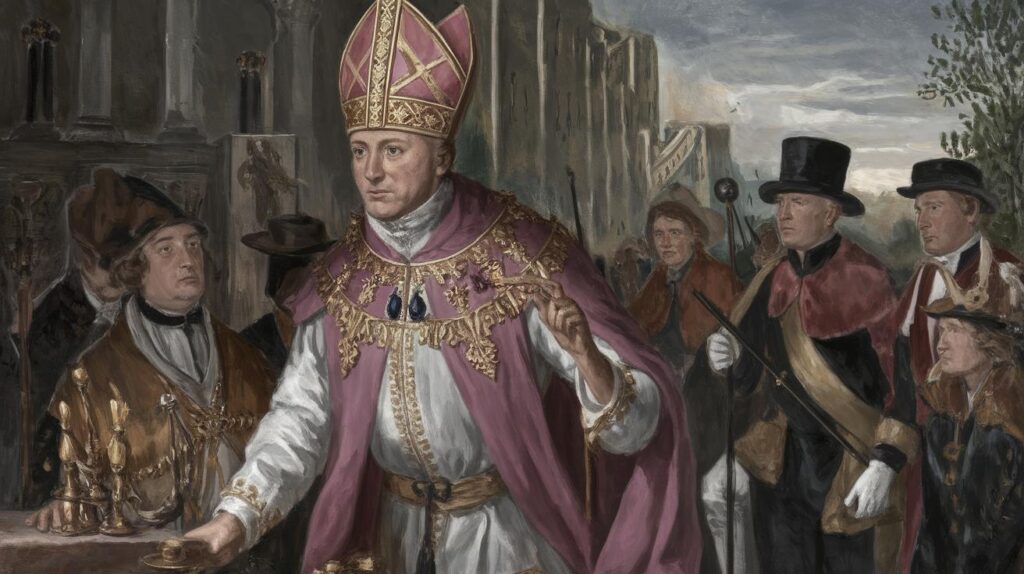
The Rise and Fall of Cardinal Wolsey
Cardinal Thomas Wolsey, a key figure in the court of King Henry VIII, remains a memorable character from the tapestry of British history. Known for his magnificent rise to power and equally dramatic fall from grace, Wolsey’s life exemplifies the volatile nature of political ascendancy during Tudor England. This blog post takes a deep dive into Wolsey’s life, exploring his meteoric rise, the influence he wielded, the allegations of manipulation that haunted him, and ultimately, his legacy. We also delve into the intricate dynamics between him and Henry VIII, the monarch he served so faithfully, yet failed to satisfy in the monarch’s most pressing concern: a male heir. Journey with us through the corridors of power in early sixteenth-century England, and discover the man behind the myth, as we uncover what truly happened to Cardinal Wolsey.
Who Was Cardinal Wolsey?
Thomas Wolsey was born in Ipswich in 1473 to relatively humble beginnings. The son of a butcher, Wolsey’s extraordinary intellect allowed him to advance quickly through the ranks of the ecclesiastical hierarchy. He was educated at Magdalen College, Oxford, where he displayed great academic prowess. Soon after, Wolsey was ordained and began to climb the ecclesiastical ladder with a series of increasingly influential appointments.
Wolsey entered the service of King Henry VII and later Henry VIII, gaining a reputation as a masterful diplomat and shrewd organizer. He quickly became the royal almoner, which allowed him direct access to the young King Henry VIII. This position provided Wolsey with the opportunity to prove his administrative talents and loyalty to the monarch, setting the stage for his eventual rise to power.
Cardinal Wolsey’s Rise to Prominence and Power
Wolsey’s star ascended rapidly under King Henry VIII; by 1515, he was appointed Lord Chancellor of England. Simultaneously, he was elevated to Cardinal by Pope Leo X, which bolstered his influence in both England and the broader European context. Wolsey quickly proved himself indispensable to Henry VIII, orchestrating significant matters of state ranging from foreign policy to church affairs.
In his capacity as both cardinal and chancellor, Wolsey functioned as a vital cog in the machinery of English governance. He commanded considerable resources and had an unprecedented level of control over both secular and ecclesiastical matters. This period marked the peak of his power, as he managed what many described as an empire within an empire, with the opulence of his lifestyle courting admiration and envy alike.
Cardinal Wolsey: Innocent Advisor or Alter Rex?
Despite his prowess and influence, Wolsey’s role was mired in controversy. His unparalleled access to the king and his ability to make or break courtiers earned him both allies and enemies. Critically, Wolsey sought to enact reforms within the Church and England’s governance systems, but his efforts often met with resistance from the nobility. These ambitions were perceived as overreaching by some, lending credence to the nickname “alter rex” or “other king” attributed to him by those critical of his expansive authority.
This delicate balance of power ultimately faltered with Wolsey’s failure to secure an annulment of Henry VIII’s marriage to Catherine of Aragon. The king’s desire for an annulment was driven by his wish for a male heir and Wolsey’s inability to deliver this from the Vatican set off a chain of events that led to his downfall. As public and private scrutiny intensified, Wolsey swiftly fell from grace, stripped of his titles and properties.
Cardinal Wolsey’s Death and Legacy
Cardinal Wolsey died on November 29, 1530, in Leicester Abbey, on his way to face the king under charges of treason. The abrupt nature of his demise sparked speculation and intrigue, providing fertile ground for the many dramatizations of his life and downfall. Some question whether his death was truly from natural causes or if his enemies hastened his end.
Despite his dramatic fall from grace, Wolsey’s legacy is multi-faceted. He remains a figure of fascination, emblematic of the capability and the peril of wielding significant power. His contributions to the development of England’s modern administrative systems cannot be understated, nor can the circumstances and consequences of his downfall in the shadow of Henry VIII’s ambitions. To this day, the story of Cardinal Wolsey serves both as a caution and an inspiration in the annals of history.
Link/cite this page
If you found this article insightful, feel free to link or cite this page in your own explorations of historical narratives. Sharing insights strengthens our collective understanding and appreciation of the complexities of history.
Share the love:
Encourage others to delve into the rich tapestry of history by sharing this article with your friends and networks. Every shared link helps fuel the curiosity and scholarly pursuit of those around us.
Final Thoughts
| Aspect | Details |
|---|---|
| Early Life | Born in Ipswich, 1473. Son of a butcher, educated at Oxford. |
| Rise to Power | Became royal almoner; later Cardinal and Lord Chancellor under Henry VIII. |
| Influence | Held significant power, influenced state and church matters. |
| Controversy | Nicknamed “alter rex”; struggled with nobility and failed annulment. |
| Downfall and Death | Died in 1530 on the way to treason charges; legacy complex but enduring. |

